

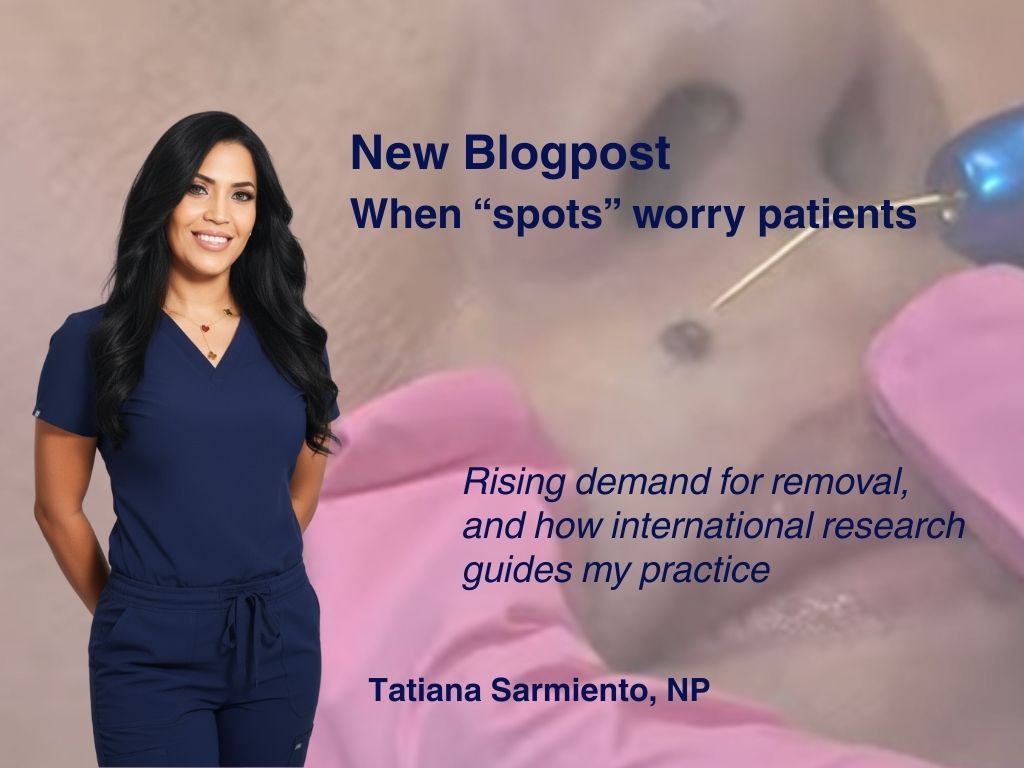
When “spots” worry patients: rising demand for removal, and how international research guides
Every week in my clinic I see patients who come in worried about a small brown spot, a raised mole, or a patch that didn’t used to be there. For many, the question is simple but heavy: “Could this be cancer?” For others the concern is aesthetic — a spot that makes them self-conscious. Lately there’s been a clear trend: more patients are asking not only for reassurance, but for removal. In this post I explain why that demand is growing, what the international evidence says about risk and treatment, and how I translate those findings into safe, patient-centred care.
Why removal requests are increasing
First, the overall demand for aesthetic procedures continues to climb worldwide — patients are more proactive about appearance and preventative care than ever before. Global aesthetic surgery and non-surgical procedure surveys report steady increases year over year, reflecting both awareness and accessibility of treatments. two forces are driving the rise in requests to remove benign-looking lesions.
Second, social media and online communities amplify attention to skin irregularities. Cross-sectional analyses of social platforms show that hashtags and posts about mole removal are common and often encourage people to seek procedures — sometimes without understanding the medical nuances. This online visibility pushes more people into clinics asking for aesthetic and diagnostic removal.
How I implement international research in my daily practice
International research and reviews show a spectrum of safe, effective options for benign pigmented lesions — from topical therapies to lasers and minimally invasive excision. Laser treatments, in particular, have robust literature supporting their use for certain pigmented conditions (for example, some lentigines and café-au-lait macules), while other lesions are better managed surgically so a histology sample is obtained. The choice depends on lesion type, depth, patient skin type, and risk factors.
According to the Nuffield Council of BioEthics, procedures for mole/lesion removal are a meaningful and growing segment of aesthetic practice, so clinics must combine cosmetic technique with medical safety protocols.
My approach blends evidence, safety, and patient values. Here’s how I translate the literature into care:
- Systematic clinical assessment first. Every patient gets a focused history (changes in size, shape, bleeding, symptoms, family history of melanoma, sun exposure) and a structured skin exam. If a lesion has any “red flags” we stop thinking about aesthetics and treat it as a possible malignancy.
- Dermatoscopy for every uncertain lesion. I use dermatoscopy as standard — it’s supported by international guidelines to improve diagnostic accuracy — and I document images for monitoring. If a lesion’s dermatoscopic features are suspicious or ambiguous, I arrange excision with histology or a specialist dermatology referral without delay.
- Shared decision-making about removal vs surveillance. For benign lesions that patients find distressing, we discuss options (laser, shave/excision, cryotherapy, conservative topical measures), the pros/cons, and the small possibility that a lesion thought benign could have atypical features on histology. I explain the cosmetic outcomes, possible scarring, and the importance of histological diagnosis when appropriate.
- Use procedures supported by evidence — and avoid “off-label” shortcuts. When selecting a device or technique I review the literature and choose modalities with documented efficacy and safety for that lesion type (for example, specific laser platforms for certain pigmentary disorders). This reduces complications and improves outcomes.
- Safety net and pathways for red flags. If pathology or clinical course raises concern, I fast-track the patient to dermatology/oncology colleagues. Collaboration and prompt referral are non-negotiable — early multidisciplinary action saves lives.
- Patient education and realistic expectations. I take time to explain the limits of any procedure: lasers may lighten spots but sometimes require multiple sessions; surgical removal gives the most reliable diagnosis; any procedure can change pigmentation temporarily. I also discuss sun protection — the single most important preventative measure.
Final thoughts: balancing appearance and safety
Patients increasingly ask to have spots removed — and that demand is shaped by greater aesthetic expectations, easier access to clinic care, and social media influence. As clinicians, our job is to honour patients’ wishes while protecting them.
International research gives us two clear priorities: use dermatoscopy and evidence-based treatments, and when in doubt obtain histology or refer. Those principles keep our practice both modern and safe.
If you’re thinking about removing a spot, my advice is simple: get assessed by someone who uses dermatoscopy, understands the treatment options and their limits, and will prioritize histology when there’s any uncertainty. That’s the model I follow every day — combining international evidence with compassionate care so patients get both the results and the safety they deserve.